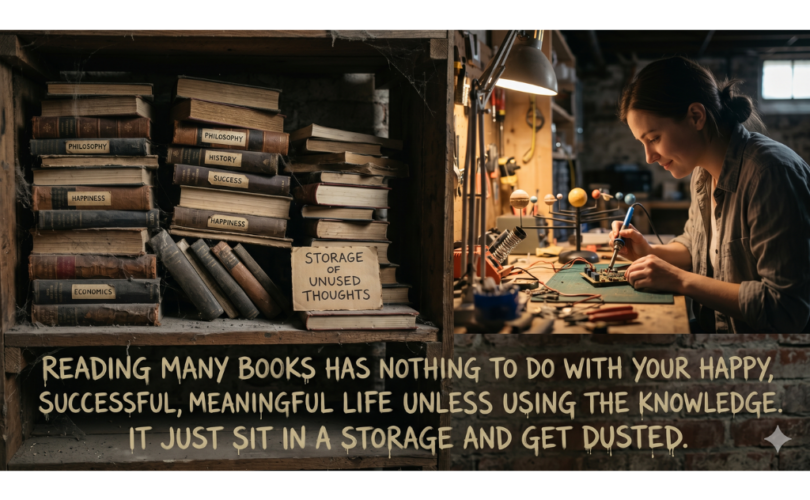
That title sounds ridiculous, doesn’t it?
How can reading books be worse than eating junk food?
After all, books are supposed to make us smarter. They expose us to new ideas, new perspectives, and sometimes even entirely new ways of living.
BUT let me ask a question. Do you know people who read a lot? I do. Also, you can see from the social media posts how many books people proudly read. Some of them read far more books than Warren Buffett. Some consume more philosophy than famous philosophers. Some know more self-improvement frameworks than the gurus who wrote them.
So why aren’t they all wealthy, wise, productive, or happy?
If reading alone were the answer, the world’s biggest libraries would be full of the most successful people on earth. Yet somehow, they are not. I think the problem is simple.
Reading is input. Life is output.
They are not the same thing. Imagine your brain as a storage room. Every book adds another box. Some people become very good at collecting boxes. They organize them neatly. They label them. They even build bigger storage rooms so they can hold more boxes.
But the boxes never leave the room. The knowledge never becomes action. What happens then? Nothing. The boxes collect dust. Some of the ideas become outdated. Eventually, much of what was carefully stored is forgotten.
So what is reading for? To fill the storage room? Or to take something out and use it?
A hammer sitting in a toolbox for ten years is still a hammer. But it has never built anything.
Knowledge works the same way.
Here’s a simple test. Think about a problem you had one or two years ago.
Stress.
Anxiety.
Procrastination.
Relationships.
Money.
Did you read a book about it? Most likely, yes. Now ask yourself: Did you actually practice what the book suggested? If you did, the problem should be smaller today. Maybe not gone completely, but smaller. If the problem is exactly the same, perhaps the issue wasn’t a lack of knowledge. Perhaps it was a lack of application.
Many of us secretly believe there must be a better answer somewhere. A more efficient method. A hidden shortcut. A miracle. One more book. One more podcast. One more video. Then everything will finally change. But what if the answer has already been sitting on your bookshelf for years?
Unread is not the problem. Unused is.
The truth is uncomfortable. Most of the wisdom we need is already available. The challenge is not finding it. The challenge is living it. And until we do, reading another book may simply be a more socially acceptable form of procrastination.
TK