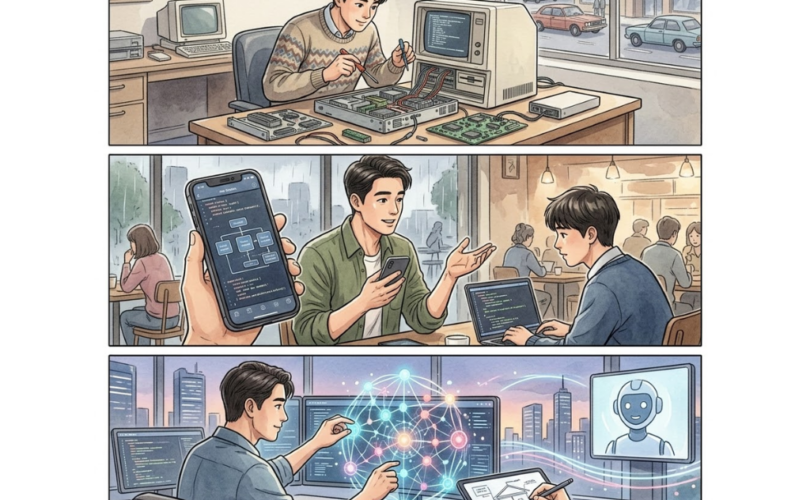
When personal computers first entered homes and offices, many people dismissed them.
“They are too complicated.”
“They will destroy jobs.”
“I don’t need one.”
History proved otherwise. The people who benefited most were not the loud critics. They were not even the casual users. The real winners were those who learned how computers worked, those who built software, improved systems, and understood the logic behind the machine.
Then smartphones arrived.
Again, skepticism followed. Some treated them as toys. Others saw opportunity. While many used smartphones for entertainment, a smaller group learned how apps functioned, how platforms scale, and how digital ecosystems create value. They did not just consume technology, they shaped it.
Today, we stand in the early years of the AI era. And the reaction sounds familiar.
“It’s dangerous.”
“It’s cheating.”
“It will replace us.”
Perhaps it will replace some tasks. But technology has always replaced tasks. What it has never replaced is the willingness to learn. The real divide in every technological shift is not between “old” and “young,” nor between “technical” and “non-technical.” It is between those who adapt and those who remain passive.
Anyone can type a prompt into an AI system. Anyone can generate text or images. But not everyone will learn how to ask better questions, how to integrate AI with human creativity, or how to build something original. There is a difference between using a tool and understanding a tool. Consumers depend on systems built by others. Creators influence those systems.
This pattern is not new. It is historical. Those who refused to learn computers eventually had to rely on those who did. Those who ignored smartphones eventually depended on platforms created by others.
AI will follow the same path.
The greatest risk today is not artificial intelligence itself. The greater risk is intellectual passivity choosing comfort over curiosity, consumption over competence. Technology does not reward spectators. It rewards participants.
The question facing us now is simple:
In the AI era, will you remain a user or will you become someone who understands, improves, and shapes the tool?
TK