The Tang dynasty writer Han Yu once described the highest standard of writing this way:
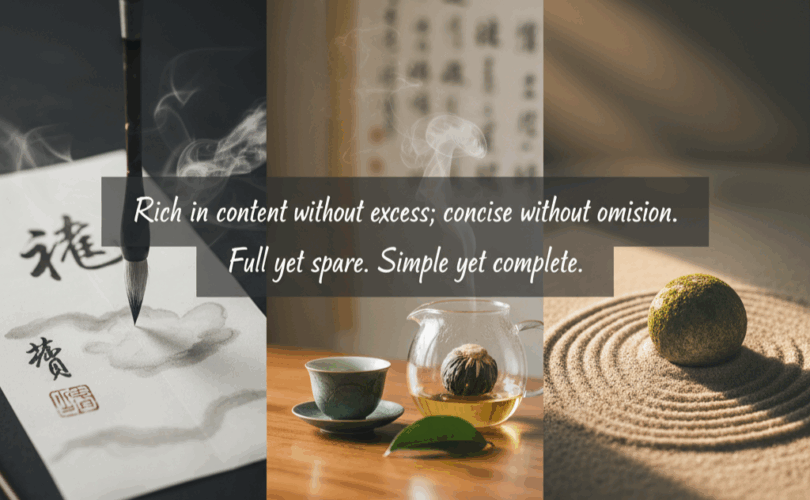
“Rich in content without excess; concise without omission.”
At first glance, it sounds like advice for literature. But the more I sit with it, the more I realize how universal it is.
Beyond Writing
- In Art: A painting that feels alive not because it overwhelms with detail, but because every stroke has meaning.
- In Speech: A message that moves us not by length, but by precision — nothing wasted, nothing missing.
- In Leadership: A plan that covers what is essential, without drowning the team in noise.
- In Life: A day lived not with endless activity, but with just enough — no excess, no lack.
Han Yu’s standard reminds us: perfection is not about adding more, but about aligning what is present with what is necessary.
Why It Amazes Me
This balance — richness without excess, simplicity without emptiness — is something we struggle with in nearly every human endeavor.
We overload presentations. We clutter our homes. We add noise to relationships.
But imagine carrying this principle into all we do:
- Write with meaning.
- Speak with clarity.
- Live with essentials.
It’s a lens not only for art, but for life itself.
Final Thought
Han Yu captured a truth that crosses centuries and cultures:
Full yet spare. Simple yet complete.
Isn’t that what we all long for — in our words, our work, and our days?