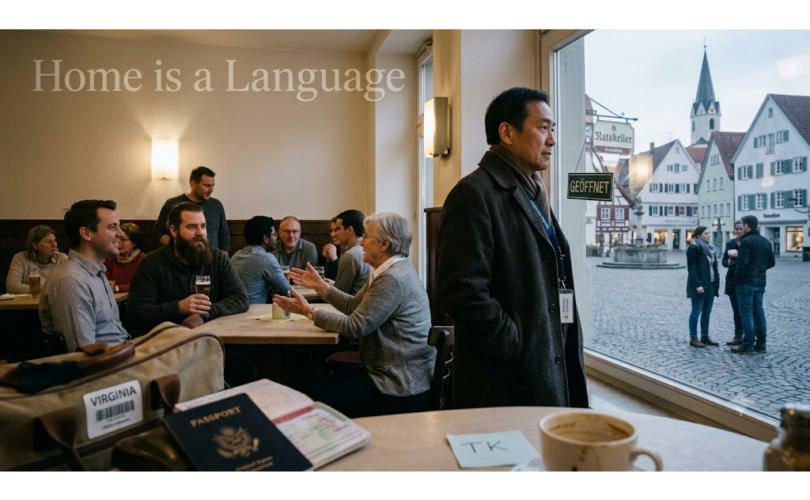
I never imagined that I could miss English this much. I’m writing this from a small town called Biberach, Germany, while visiting my customer at Boehringer Ingelheim.
I’m Korean by birth, Canadian by citizenship, and I live in the United States. Yet here, for the first time, I realized how much I depend on English. Almost everyone around me speaks German. The only person I’ve met who speaks English fluently is a traveler from Virginia.
For the first time in years, I feel what it means to be outside the conversation.
It’s a strange feeling. The people I pass on the street don’t look very different from the people I see everyday in America. Also, biologically, we’re almost identical. Scientists often say that all humans share more than 99.9% of our DNA.
However, I cannot become one of them. Not because of my face(?) and Not because of my culture, but only because I don’t speak their language.
That made me wonder. Language might be much more than a tool for communication. Maybe language is how humans recognize who belongs. It creates communities. It allows strangers to trust one another, cooperate, and survive. Without language, civilization would never have existed.
But the same thing, Language, that brings people together also separates them. Every language creates an invisible circle. Inside the circle, there is understanding. Outside the circle, there is distance.
Not because people intend to exclude one another, but because they simply cannot fully understand each other. Maybe that is one of language’s greatest paradoxes. It helps us survive together. And at the same time, it divides us.
That is why so many conflicts begin with words, identities, and the stories we tell about “us” and “them.”
Standing in a foreign country, I realized something unexpectedely. I wasn’t just missing English, but I was missing the feeling of belonging that comes with speaking it. Maybe home is not only a place. Sometimes, home is a language.
TK