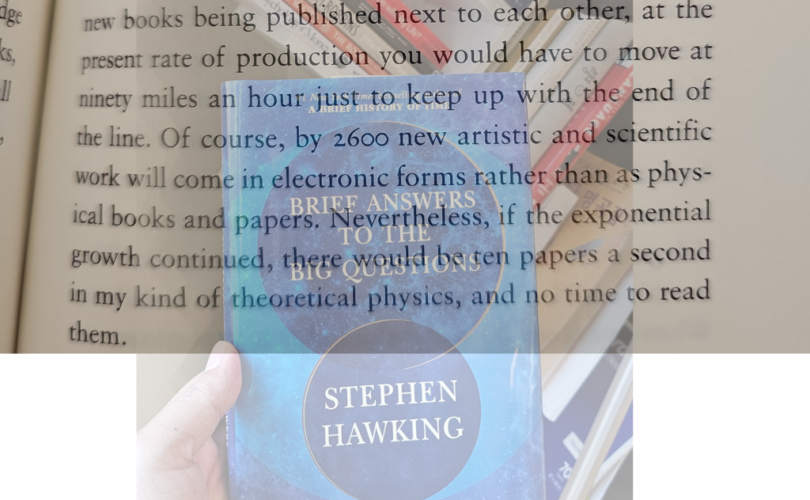
I recently came across a passage in Stephen Hawking’s Brief Answers to the Big Questions that made me stop reading to think about something.
Hawking pointed out that if the number of books continues to grow at its current pace, we will never be able to keep up. If you ever wanted to pace, then you’ll need to go 90 miles/h. At one point, he even imagined a future where scientific papers in his own field would appear so quickly that there would be no time to read them.
One of the greatest minds in modern science accepted something many of us still resist.
You cannot read everything. That acknowledgement changes the purpose of reading. When we were young, we believed knowledge was limited. Going to the library, or buying a book to collect more information. But today, information is almost infinite. Even though you devoted every waking hour to reading, millions of books would still remain unopened.
So the question is no longer, “Which book should I read?”. The better question is, “Who am I trying to become?” Because the answer of whom determines the books worth reading. We often choose books as if our goal is to finish them. But that won’t be the goal any more. The goal is to let one good idea change the way we live. If a single sentence changed how you raise your child, or how you treat your spouse, or how you spend your mornings, then that one sentence could have been worth more than reading one hundred books.
The issue is that we now spend more time choosing books than applying them. We compare reviews, and watch YouTube summaries. Find “Top 100 Books You Must Read Before You Die.” Then what, another list pops up. And another. Stephen Hawking accepted that he would never read everything. Not because knowledge isn’t valuable, but because wisdom has never come from knowing everything.
It comes from living something deeply. Maybe the best book isn’t the next one on your shelf. It can be the one you’ve already read but never practiced. Our problem is not that there are too many books, but there are too few books that become part of who we are.
TK