From atoms to animals to AI — is there one system that connects it all?
In his final book, Brief Answers to the Big Questions, Stephen Hawking defined science as the rational understanding of nature. Science, he said, is not just knowledge — it’s a structured way of seeing the world based on testable laws.
Gravity, thermodynamics, electromagnetism — all describe the mechanics of how nature works.
But as I read his words, one thought kept returning:
If science is the study of nature’s patterns, why don’t we have a unified science for interaction itself?
Not just human relationships. Not just biology or social behavior.
But a rational, interdisciplinary law that explains how anything that exists relates to anything else — from atoms to organisms to civilizations to galaxies.
🌐 Interaction: The Unnamed Constant
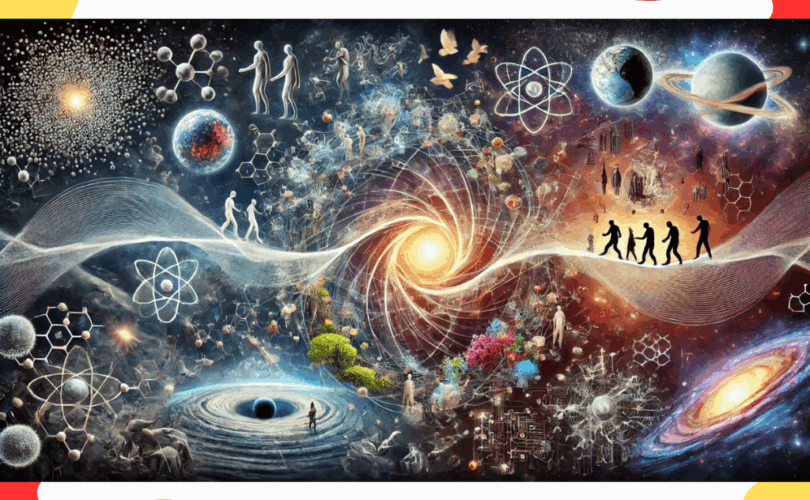
Look closely at everything we know:
- Atoms attract or repel each other.
- Cells communicate through chemical signals.
- Wolves organize in packs; birds migrate in formation.
- Humans argue, cooperate, trade, build nations.
- Planets orbit, stars collide, black holes consume.
All of this is interaction — the invisible thread that connects all things.
And yet, there is no formal “Law of Interaction” in science.
Why?
Possibly because we’ve studied the parts, but not the pattern that runs through them all.
🔍 What Might the Law of Interaction Contain?
Just like physics gave us gravity and biology gave us evolution, a Law of Interaction could offer fundamental principles observed across all systems:
| Principle | Description | Seen In |
|---|---|---|
| Attraction / Repulsion | Things pull together or push apart | Atoms, ecosystems, human relationships |
| Reciprocity | What one system gives or takes affects the other | Immune responses, trust, game theory |
| Threshold Sensitivity | Change only occurs when energy crosses a boundary | Neurons, tipping points, social revolutions |
| Emergence | Small parts interact to form complex wholes | Ant colonies, economies, consciousness |
| Energy Transfer | All interaction has cost or consequence | Thermodynamics, burnout, planetary orbit |
| Information Exchange | Signal is always embedded in connection | DNA, memes, language, AI training data |
This would not be a single formula, but a science of patterns — much like complexity theory or systems dynamics — that helps us understand how influence flows through nature at all levels.
🧠 Why It Matters More Than Ever
In the age of AI, climate collapse, cultural division, and rapid technological acceleration, our biggest challenges are not technical — they are relational.
- Can humans and machines collaborate without domination?
- Can nations solve global problems across cultural boundaries?
- Can individuals thrive in systems designed for scale, not intimacy?
These are not just political or ethical questions. They are interactional questions — questions of system feedback, boundaries, trust, adaptation, entropy, scale.
Yet we rarely approach them from a unified framework.
We argue about the outcomes, but we haven’t defined the underlying logic.
🌱 From Self to Cosmos: Why This Is Personal
I’m not a physicist. I’m an engineer by trade, a coach by calling, and a father by heart.
But in every role I’ve played — from repairing machines in biotech labs to mentoring immigrant professionals, from learning psychology in my 50s to raising kids between cultures —
everything came down to interaction.
Success, failure, growth, misunderstanding, creativity — all of it.
That’s why I believe:
Interaction is not a soft skill. It is a universal system.
It’s not less scientific than gravity — we just haven’t named it properly.
🛠 The Future Field: Interaction Science
What if we built a formal discipline — Interaction Science — that draws from:
- Systems theory
- Evolutionary biology
- Behavioral psychology
- Game theory
- Cybernetics
- Network analysis
- AI-human feedback models
We already have the parts. What we need now is the frame — a unified lens to model how entities of any kind influence and adapt to one another.
Not just to understand connection — but to design it.
🧭 A Final Thought: Naming the Invisible Thread
If gravity binds the planets,
and empathy binds people,
and memes bind culture,
and code binds machines —
then interaction is not just a feature of reality.
It is the condition for reality to exist at all.
So maybe it’s time to do what science has always done:
Observe the invisible.
Name it.
Model it.
Use it to shape a wiser future.
Let’s call it what it is:
The Law of Interaction.