When I was young in Korea, I was told to walk on the left side. I never questioned it. That was simply how people did it. When something is taught early, it feels natural and correct.
Years later, I moved to Canada. That’s when I noticed something strange. People walked on the right side. At first, it felt awkward. My body would automatically drift to the left. But slowly, I adjusted. Habits can change when the environment changes. Then I began to notice something interesting.
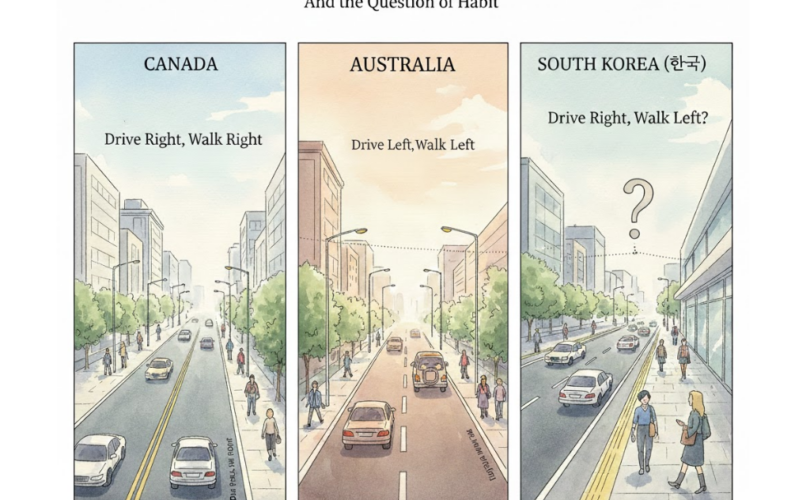
In Canada, cars drive on the right side of the road. People also walk on the right side of hallways and sidewalks. The traffic flow matches. It creates a consistent direction. It makes sense.
Now I visit Sydney, Australia for business. Here, cars drive on the left side of the road. And people walk on the left side too. Again, the system is consistent. The driver’s seat is on the opposite side compared to North America, and the logic remains aligned. Vehicles and pedestrians follow the same directional pattern.
That made me pause. If consistency between cars and pedestrians makes sense in Canada and Australia, what about Korea?
In Korea, cars drive on the right side, just like in North America. But people are taught to walk on the left.
Why? Where did that idea come from?
Is it historical influence? Military systems? Urban planning decisions? Cultural habit? I realized I had followed this rule my entire childhood without ever asking where it began.
Then my curiosity expanded. What about London, where cars drive on the left. Do pedestrians also keep left? What about Japan, which side does people walk? Is Korea unique in separating walking direction from driving direction? Or is this more common than I think?
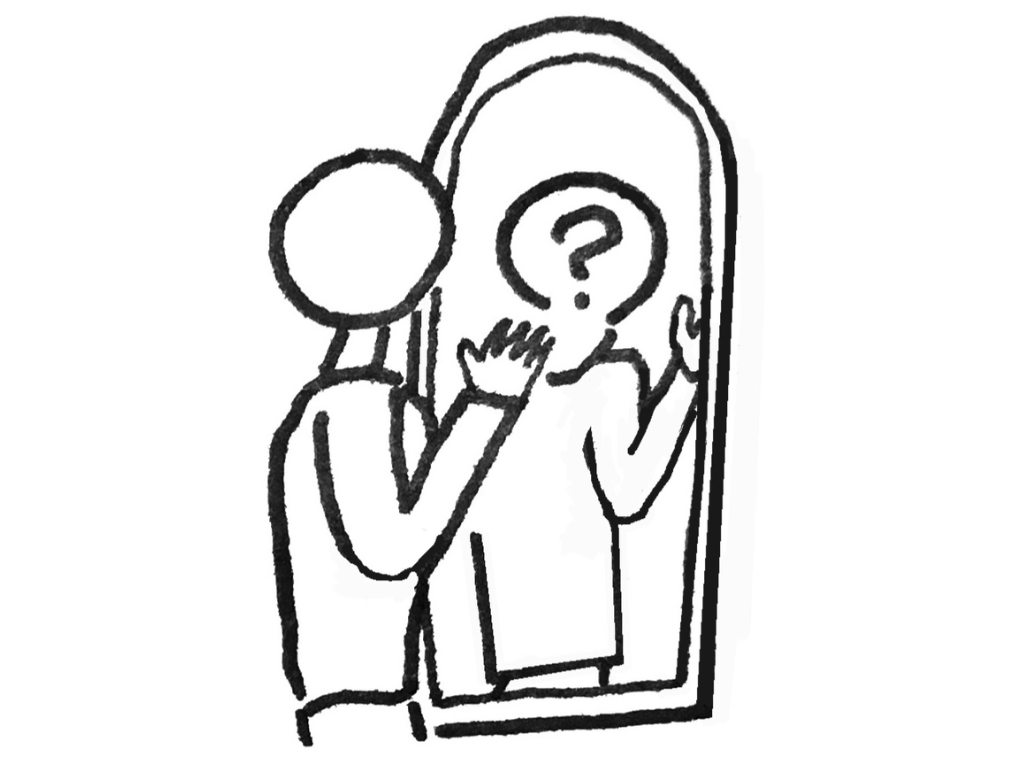
The real question is not about traffic, but is about how easily we inherit patterns without examining them. Walking direction feels trivial. But it reveals something meaningful that many of our “natural” behaviors are simply learned systems. They are not universal truths. They are just agreements.
And when we move across cultures, those agreements change. What feels obvious in one country feels strange in another. Yet each system works perfectly within its own logic. So perhaps the real lesson is.
Most of what we call “normal” is simply what we were first taught.
And sometimes, it takes crossing a border to realize how many invisible rules we carry without ever asking WHY.
TK