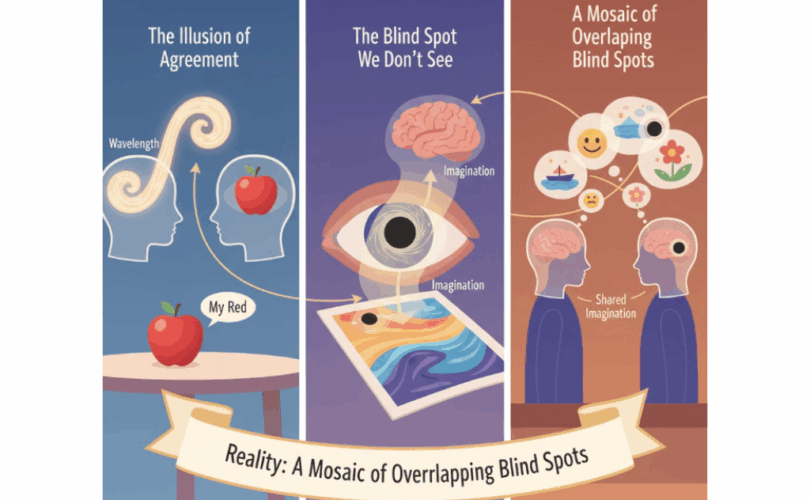
We like to think of “real” as something objective — solid, measurable, and agreed upon. But the truth is, even the so-called objective world is not conclusive. Reality, as we live it, is partly built on shared imagination.
1. The Illusion of Agreement
Take color, for example.
We agree that this object is red or yellow.
Yet what we see as red is only a wavelength of light, filtered through our sensory limits and interpreted by our brain. It’s a social agreement, not a universal truth. We don’t perceive the world as it is — only as our senses and language allow us to.
2. The Blind Spot We Don’t See
There’s a literal hole in our vision — the optic blind spot where the optic nerve meets the retina. In theory, it should appear as a dark void. But it doesn’t.
Your brain quietly fills it in with surrounding information, imagining what should be there. That imagined patch feels just as real as what you truly see.
We could say the same about a car’s blind spot — we use sensors or mirrors to compensate. But in human perception, the “sensor” is imagination. Our mind becomes the substitute for missing data.
3. The Blind Spots Beyond Vision
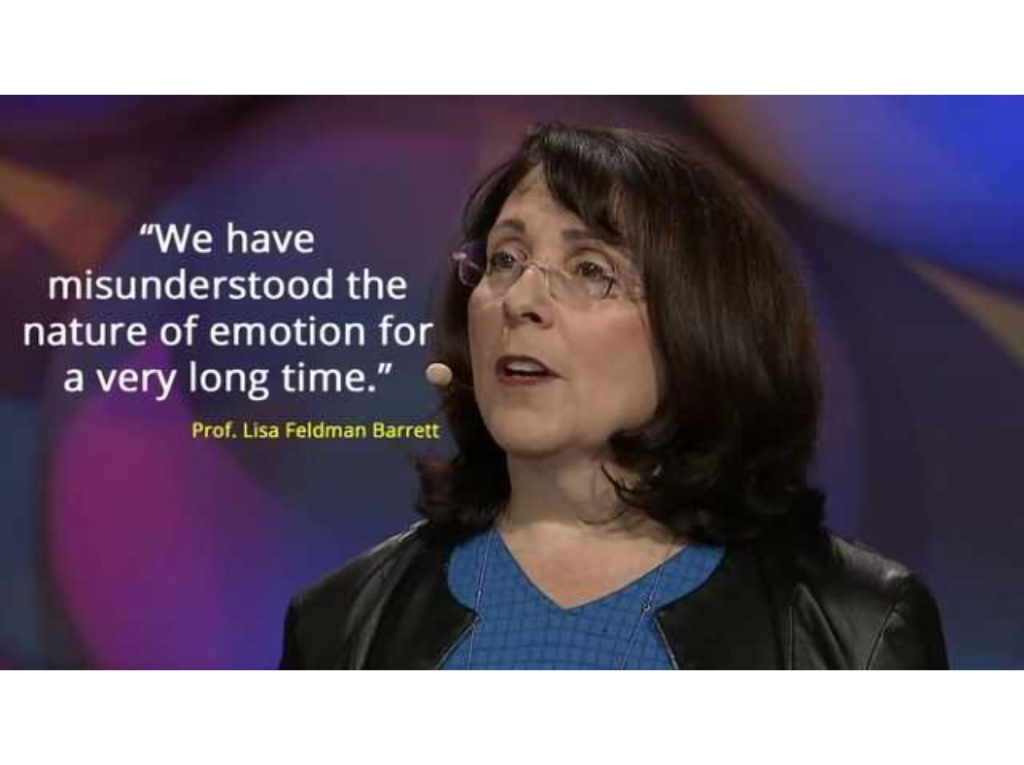
Now, imagine how this applies to communication and relationships.
We think we understand others, but we constantly fill in gaps
what someone “must have meant,”
how they “must have felt.”
We build continuity between what we know and what we guess. It works — until it doesn’t.
We don’t see the blind spots of understanding or emotion, because imagination bridges them seamlessly.
We live inside a perceptual illusion — one convincing enough that we call it reality.
4. The Imaginary Consensus
If that’s the case, then perhaps reality is not something we discover, but something we synchronize through shared imagination.
We call it “real” when enough of us imagine the same thing. Money, nations, religion, even love — each depends on collective imagination aligning just enough to function.
But that alignment is never perfect. No two people see exactly the same world, hear the same tone,
or feel the same truth.
So, the reality we inhabit together is not a mirror — it’s a mosaic of overlapping blind spots.
Final Thought
To align reality with another person is to dream in near-synchrony — to imagine in parallel.
And since perfect alignment is impossible, perhaps true understanding is not about eliminating blind spots, but about learning to imagine together more honestly.