We live in a time of endless information. Books, podcasts, and online courses flood our minds with advice on how to live better, work smarter, and grow stronger. Yet many of us still ask:
“Why doesn’t all this knowledge actually change my life?”
The answer lies in neuroplasticity—the brain’s ability to rewire itself. And the truth is, not all learning is created equal.
1. Reading and Doing Are Not the Same
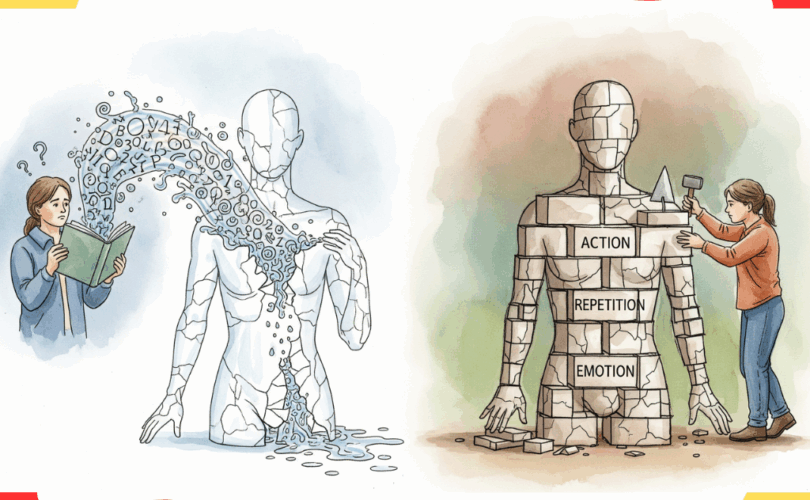
When you read, especially non-fiction or self-help material, your prefrontal cortex lights up. This part of the brain is responsible for reasoning, planning, and abstract thought.
That’s how you gain explicit knowledge—knowing what you should do.
But behavioral change happens elsewhere. It requires the basal ganglia and motor cortex, which govern habits, routines, and actions. Without activating these regions, what you “know” rarely translates into what you “do.”
2. Experience Creates Stronger Wiring
Neuroplasticity works best when linked to emotion, repetition, and sensory-motor engagement.
- Making a mistake and correcting it
- Practicing a new routine until it feels automatic
- Feeling emotional highs or lows connected to action
- Receiving real-world feedback
These experiences strengthen synapses. Unlike passive reading, they rewire the brain in lasting ways.
3. The Self-Help Paradox
This explains why so many people consume self-help books yet still feel stuck.
Reading creates the illusion of progress. But without embodiment and repeated practice, the brain doesn’t achieve long-term potentiation (LTP)—the neurological foundation of memory and behavioral change.
Knowing is not doing.
4. What Science Tells Us
- Procedural vs. Declarative Learning: Educational psychology shows that learning by doing (like riding a bike) is stored differently than learning by reading (like memorizing bike safety rules).
- Damasio’s Somatic Marker Hypothesis: Our real-life decisions are shaped more by emotion-filled experiences than by rational knowledge alone.
- Hebbian Learning: “Neurons that fire together, wire together.” Repeated, emotionally engaging actions forge durable pathways.
5. Turning Knowledge Into Transformation
So how do we bridge the gap? Here are a few science-backed practices:
- Action-based learning: Apply one concept immediately instead of storing it for “later.”
- Spaced repetition & habit stacking: Repeat consistently, link it to existing routines, and reward progress.
- Emotional engagement: Tie your learning to something that matters deeply to you.
- Accountability structures: Use coaching, group challenges, or journaling to keep practice alive.
Final Thought
Knowledge can inspire you.
But only experience can transform you.
If you feel stuck after reading book after book, it’s not because you’re broken—it’s because your brain needs more than words. It needs action, repetition, and emotion to rewire.
So next time you read something life-changing, don’t stop at understanding.
Step into the experiment.
That’s where change begins.